Comic Palm: The Tropical Accent for Bold Creative Statements
In the dense forest of available fonts, where scripts range from austere minimalism to ornate complexity, a typeface emerges not with a whisper but with a vibrant, leafy shout. Comic Palm is a font that defies the typical categories. It is not merely a tool for setting text; it is a visual element, a decorative asset that carries the energy of a tropical breeze into any layout. Its character lies in its ability to inject personality instantly, transforming a mundane headline into an invitation, a bland label into a celebration.
The Anatomy of a Playful Script
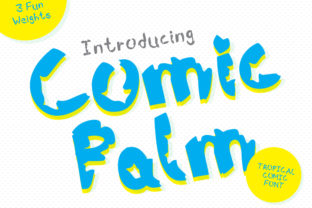
To understand Comic Palm, one must look at its construction. Unlike traditional cursive scripts that aim for fluid, connected elegance, Comic Palm operates with a deliberate, almost illustrative quality. Each letterform is drawn with a thick, consistent stroke weight, reminiscent of bold marker pen lines. The curves are generous and rounded, avoiding sharp angles to maintain a soft, approachable feel. This foundational boldness gives it substantial visual weight on any page or screen.
The true signature, however, is in the embellishments. Many characters, particularly the capitals and terminal letters, feature stylized palm leaf motifs. A sweeping serif might curl into a frond-like shape; the tail of a 'y' could resemble a tropical plant. This is not a subtle, textural detail but a clear graphic element integrated into the letter itself. The font’s name is therefore a direct descriptor: it is "comic" in its bold, cartoonish line quality, and "palm" in its thematic adornment. This combination results in a typeface that is inherently decorative and context-driven.
Where Comic Palm Thrives: Unconventional Applications
The practical use of Comic Palm begins with recognizing its primary role: it is an accent font. Its high personality and strong thematic tie make it unsuitable for long body text or formal documentation. Instead, its power is unleashed in specific, targeted applications where making a visual statement is paramount.
Consider event branding. A summer festival poster, a beachside café’s menu board, a children’s activity camp logo—these are environments where Comic Palm communicates the theme instantly. The font doesn’t just say "Tropical Party"; it visually embodies it. In digital spaces, it can be incredibly effective for singular, impactful headlines on websites promoting travel, leisure, or eco-friendly products with a natural vibe. A single phrase like "Explore Paradise" or "Fresh Flavors" set in Comic Palm can set the entire tone for a page.
Beyond commercial uses, creators find value in its illustrative quality. Graphic novel artists might use it for specific chapter titles or character shout text. Educators designing materials for young children could employ it for activity headers to make learning sheets feel more engaging and fun. Hobbyists creating personal projects, such as custom t-shirts for a family reunion or signage for a garden party, can leverage its ease of recognition and cheerful demeanor.
Strategic Advantages and Key Considerations
Choosing Comic Palm offers distinct advantages, but these come with necessary considerations for effective implementation.
The foremost advantage is immediate thematic association. It shortcuts the design process by carrying a pre-established mood. This can be a tremendous efficiency for designers working on projects with clear environmental or emotional themes. Secondly, its bold weight and unique shapes make it highly legible at larger sizes, even from a distance, which is crucial for posters and signage. Finally, its novelty acts as a memorability factor. In a sea of standard sans-serif logos, a brand element using Comic Palm can stand out and create a more lasting visual impression.
However, these strengths dictate careful usage. The font’s specificity means it can feel jarring or inappropriate if used outside its thematic wheelhouse. Applying it to a financial report or a technical manual would undermine both the document's seriousness and the font’s charm. It is also a font that demands space. It needs to be used at a sufficient size to allow its decorative details to breathe and be appreciated. Cramming it into small button text or dense paragraphs will obscure its features and reduce legibility.
Another consideration is pairing. Comic Palm rarely works as a standalone typographic solution. It requires companion fonts. A neutral, clean sans-serif like a geometric or humanist style is often the best partner. This pairing creates balance: the sans-serif handles all the functional, readable text (body copy, captions, details), while Comic Palm reserves its energy for the primary visual punchpoints. This contrast ensures the design remains practical and accessible without drowning in decorative flair.
Integration into Modern Design Workflows
For the contemporary designer or creator, integrating a font like Comic Palm into a workflow is straightforward, but mindset is key. It begins in the conceptual phase. When brainstorming for a project with a tropical, casual, playful, or natural theme, Comic Palm becomes a candidate asset from the outset. It should be placed into mock-ups early to test its visual impact against the overall layout.
In digital design software, from professional Adobe suites to simpler web-based editors, the font behaves like any other. Its vector forms scale perfectly. A crucial workflow step is the testing of pairings, as mentioned, and the establishment of a clear typographic hierarchy. One might establish a rule: H1 headings in Comic Palm, H2 and H3 in a bold sans-serif, and all body text in a regular weight of the same sans-serif family. This creates a structured, scalable system.
For web implementation, the usual considerations for script fonts apply. Ensure the font file is optimally compressed for web use to maintain page performance. Given its decorative nature, it may be wise to only load Comic Palm for specific, headline elements rather than as a universal font for the entire site, preserving loading speed. Also, always check fallback behaviors; if the font fails to load, the chosen sans-serif backup should maintain the layout’s integrity.
Observations on Trend Resilience and Authenticity
Typography trends evolve rapidly, with some fonts feeling dated within a few years. Comic Palm, due to its highly thematic and non-abstract nature, occupies a different space. Its relevance is tied less to general typographic fashion and more to the enduring popularity of tropical, natural, and retro-comic aesthetics in culture. As long as designs evoking summer, vacation, nature, or playful nostalgia are in demand, Comic Palm will have a potential application.
Its use also touches on a broader principle in design: authenticity of expression. When a font’s character so directly aligns with a project’s core message, the result feels cohesive and intentional. A travel blog about Caribbean islands using a cold, minimalist font might feel disconnected. Using Comic Palm for key titles could strengthen the authentic voice of the content. This alignment between form and content is a hallmark of thoughtful design, moving beyond mere decoration to reinforced communication.
Ultimately, Comic Palm is a specialist in the typographic toolkit. It is not the wrench you use for every bolt; it is the custom tool for a specific task. Its value is unlocked when the design context calls for energy, a naturalistic flair, and an unapologetically cheerful tone. For the business owner launching a beachwear line, the educator crafting a rainforest-themed learning module, or the hobbyist designing a luau party invitation, this cute script with a tropical feel offers a direct path to making their project not just visible, but vividly memorable.
In practice, its application reminds us that typography is more than information delivery. It is atmosphere creation. Comic Palm, with its bold strokes and leafy serifs, builds an atmosphere of warmth, leisure, and organic vibrancy. By understanding its characteristics, respecting its thematic boundaries, and pairing it strategically, creators can harness this atmosphere to make any design project stand out with confidence and a smile.